



Why Is Maintaining Color Consistency in Fabrics Such a Challenge?
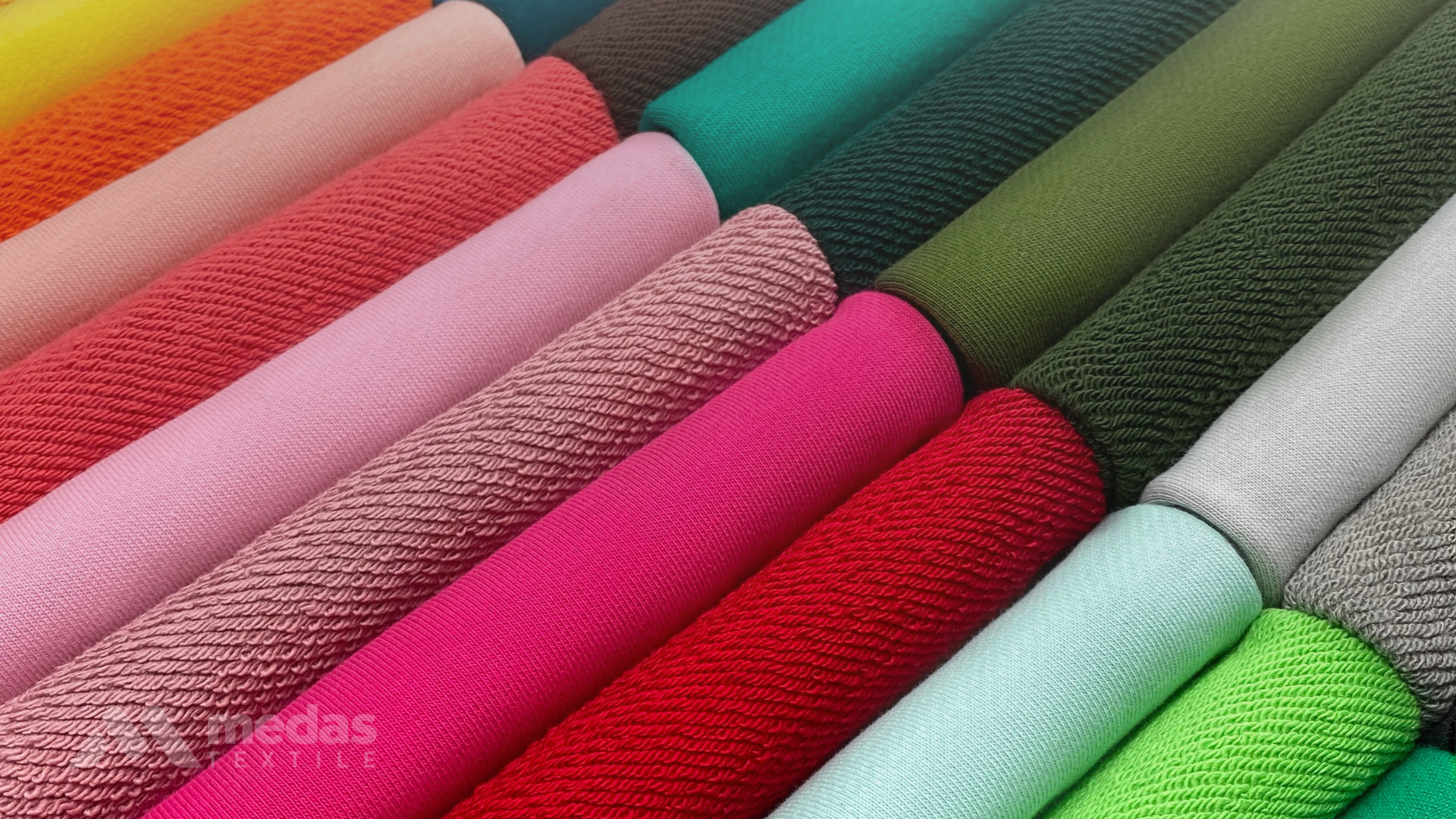
Why is maintaining color consistency in fabrics already a challenge at the design stage - and an even greater one during production? This question regularly arises in the textile industry, from designers and technologists to quality control departments. Color is one of the first elements customers notice. It influences the perception of the product, the coherence of a collection, and the credibility of a brand. At the same time, it is one of the most difficult parameters to fully control.
In this article, we explain why color consistency in fabrics - especially knitted fabrics - is a real technological challenge. We discuss the entire process, from raw materials and fabric dyeing during production to the influence of trends and market expectations, including color trends in knitted fabrics. This text was prepared for readers who want to understand the issue on a deeper level.
Table of Contents
- Why is maintaining color consistency in fabrics a challenge already at the raw material stage?
- The process of dyeing knitted fabrics during production
- Pigment dyeing
- Why is maintaining color consistency in fabrics a challenge in knitted fabric production?
- Printing on knitted fabrics
- The sewing stage and maintaining color consistency in fabrics
- Why is maintaining color consistency in fabrics a challenge when scaling production?
- Color trends in knitted fabrics and color consistency
- Table – factors affecting color inconsistencies
- FAQ – frequently asked questions
Why Is Maintaining Color Consistency in Fabrics a Challenge Already at the Raw Material Stage?
Why is maintaining color consistency in fabrics a challenge even before the material reaches the dye house? The answer is simple — fibers are not identical. Even within the same type of raw material, such as cotton or viscose, there are differences resulting from origin, production batch, humidity, or storage conditions.
Knitted fabrics, due to their looped structure, react differently to dyes than woven fabrics. Elasticity, loop density, and yarn twist all affect how deeply the dye penetrates the material and how the color is visually perceived afterward. This means that color consistency is not a zero-one value, but rather a range of acceptable variations.
The Process of Dyeing Knitted Fabrics During Production
Why is maintaining color consistency in fabrics such a challenge in the dye house itself? Because dyeing is a chemical process that requires absolute control over many variables at the same time. Temperature, processing time, dye proportions, fiber type, and material weight — each of these elements has a direct impact on the final result.
Professional dyeing requires prior cleaning of the material from dust, chemical residues, and contaminants created during knitting and storage. Even a minor oversight at this stage can result in shade differences within the same production batch.
That is why dyeing knitted fabrics during production must be strictly monitored and carried out according to repeatable technological procedures.
Pigment Dyeing
Maintaining color consistency in fabrics is particularly challenging with pigment dyeing. Unlike soluble dyes, pigments do not dissolve in water. They are fine powder particles, often derived from inorganic substances such as iron oxide or from organic carbon compounds. Pigment dyeing of fabrics and knitted materials requires the use of special solvents and fixing agents that allow the pigment to penetrate the fiber structure and remain there permanently. Any deviation in proportions or processing time can lead to color differences, especially visible on large material surfaces.
Why Is Maintaining Color Consistency in Fabrics a Challenge in Knitted Fabric Production?
Why is maintaining color consistency in fabrics a challenge within the entire knitted fabric production process? Because color is not created in a single moment. It is the result of a sequence of processes — from knitting, through dyeing, to finishing.
Circular knitting, flat knitting, or jacquard knitting all influence the structure of the material and, consequently, the perception of color. Two knitted fabrics with the same composition but different knit structures may look different after dyeing, even when the identical dye recipe is used.
Printing on Knitted Fabrics
Printing adds another layer of color that must work harmoniously with the base shade of the knitted fabric. In processes such as printing on knitted fabrics, not only the quality of the printing ink matters, but also the absorbency of the material and its prior finishing treatment.
Digital printing, screen printing, and transfer printing each react differently with the substrate. As a result, maintaining a uniform visual effect across an entire production series requires highly precise sample testing.
The Sewing Stage and Maintaining Color Consistency in Fabrics
Why is maintaining color consistency in fabrics a challenge even after dyeing and printing are completed? Because sewing introduces additional variables. Knitted fabrics are elastic and susceptible to stretching and tension, which can affect the perception of color in the finished product.
A professional sewing facility must work with materials from the same dye batch. Combining knitted fabrics from different dye baths almost always leads to visible color differences, especially in light and highly saturated shades.
Why Is Maintaining Color Consistency in Fabrics a Challenge When Scaling Production?
Why is maintaining color consistency in fabrics a challenge at higher production volumes? Because scale amplifies every error. What is barely noticeable in a short production run becomes a serious issue when producing thousands of meters of material.
A change of raw material supplier, a different dye batch, or even a slightly different process temperature — each of these factors can influence the final color. This is why manufacturers offering a full range of services, from dyeing facilities to sewing production, have a real advantage in quality control.
Color Trends in Knitted Fabrics and Color Consistency
Why is maintaining color consistency in fabrics a challenge in the context of fashion and the market? Because color trends in knitted fabrics change faster than production technologies. Customers expect perfectly reproduced, often highly unconventional shades that are difficult to replicate consistently on a mass scale.
Seasonal colors inspired by nature or digital palettes often push the limits of technological possibilities. The more complex the shade, the more difficult it becomes to maintain repeatability across production batches.
Table – Factors Affecting Fabric Color Consistency
| Process Stage | Main Risk of Color Differences |
| Raw Material | differences between fiber batches |
| Dyeing | temperature, time, proportions |
| Pigment Dyeing | pigment settling |
| Printing | absorbency of the knitted fabric |
| Sewing | combining different batches |
| Production Scale | accumulation of deviations |
FAQ – Frequently Asked Questions
Why is maintaining color consistency in knitted fabrics so challenging?
Because the looped structure of knitted fabrics affects dye absorption and the perception of color.
Does dyeing knitted fabrics during production always produce identical results?
No. Even when using the same recipe, slight differences may appear between production batches.
How do color trends in knitted fabrics affect production?
They require the use of more complex shades that are more difficult to reproduce consistently.
Why is maintaining color consistency in fabrics challenging with large orders?
Because larger production scales increase the risk of accumulating small technological deviations.